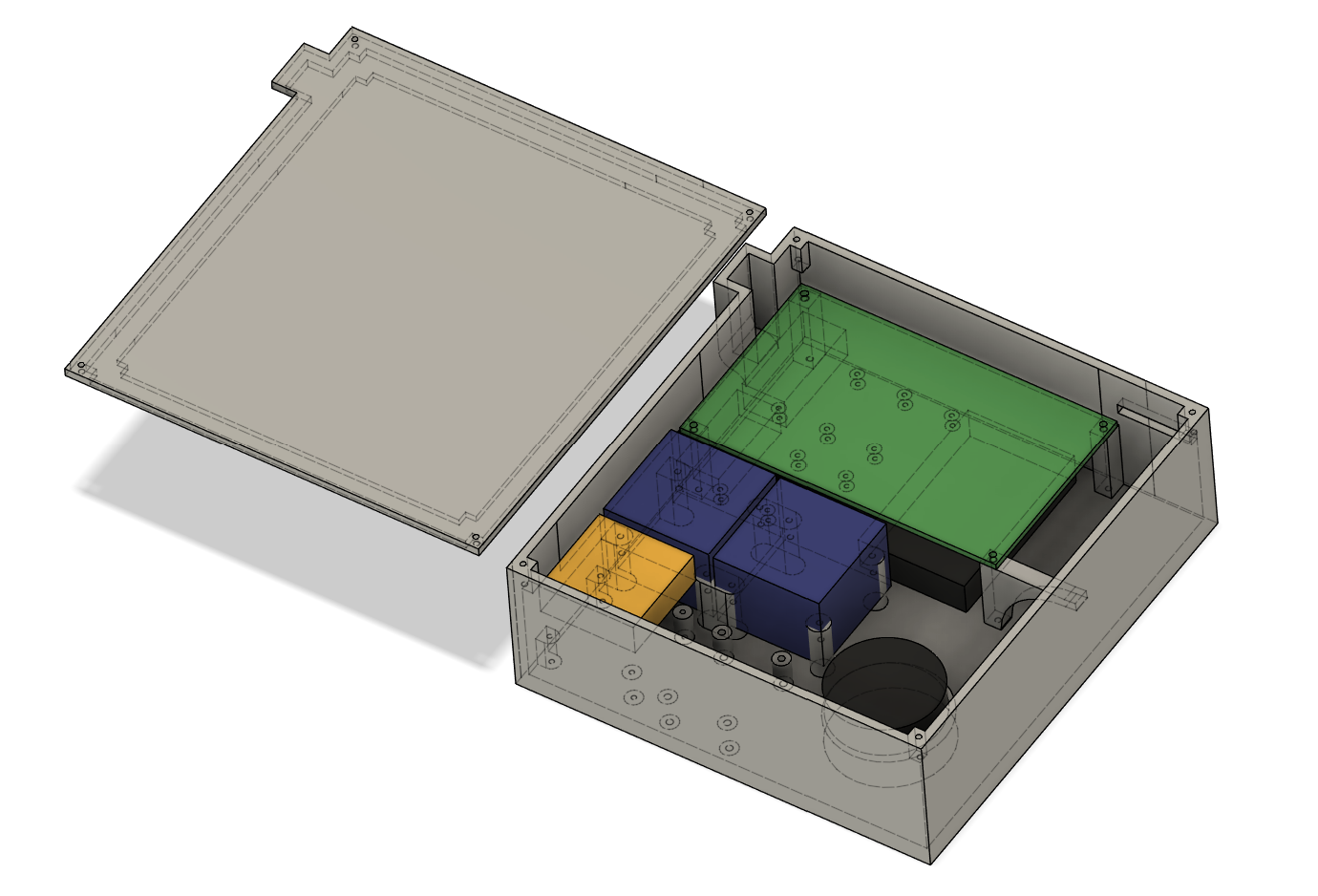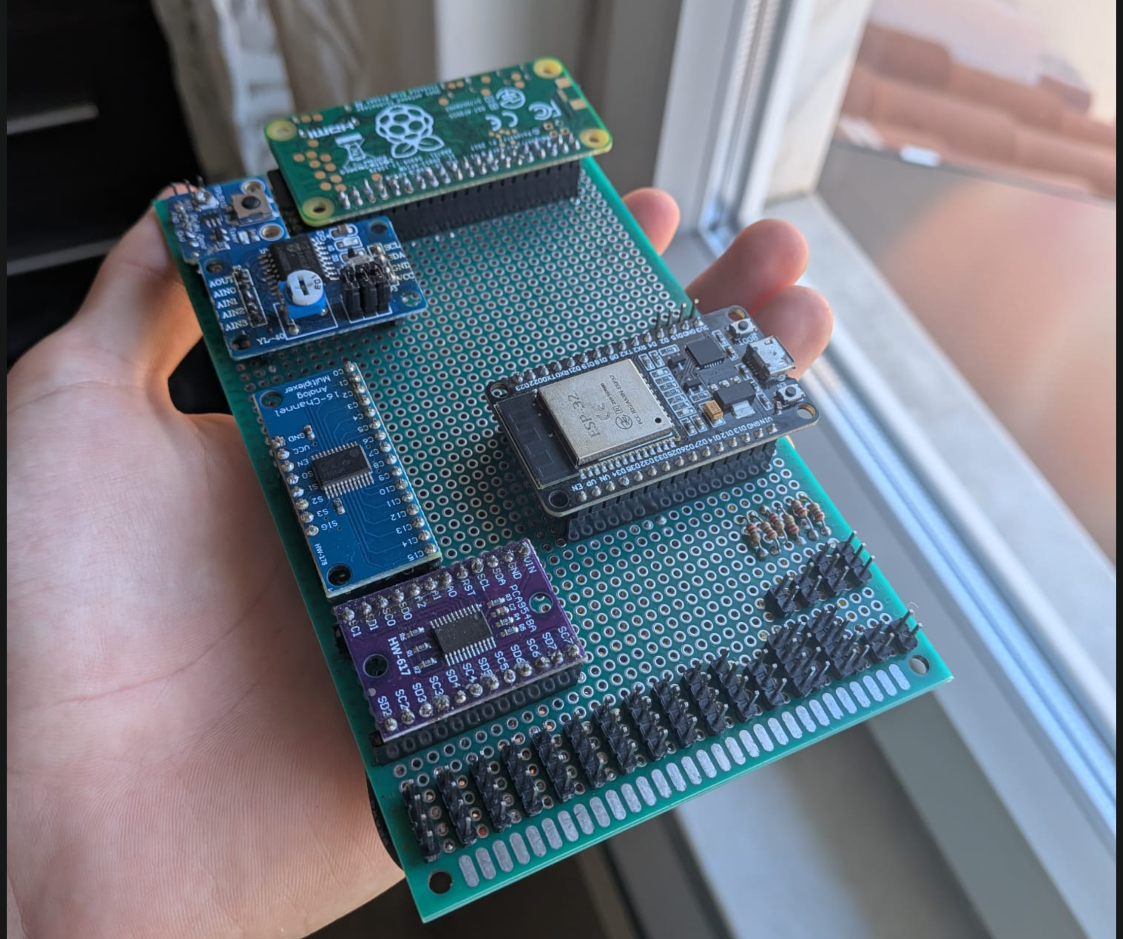
This is the main brain of SAILONE. A single prototyping board that carries every component the boat needs to navigate, sense its environment, and stay in contact. Raspberry Pi, ESP32, sensor multiplexers, analog inputs, and all the wiring connections in one place. Compact, deliberate, and almost complete.
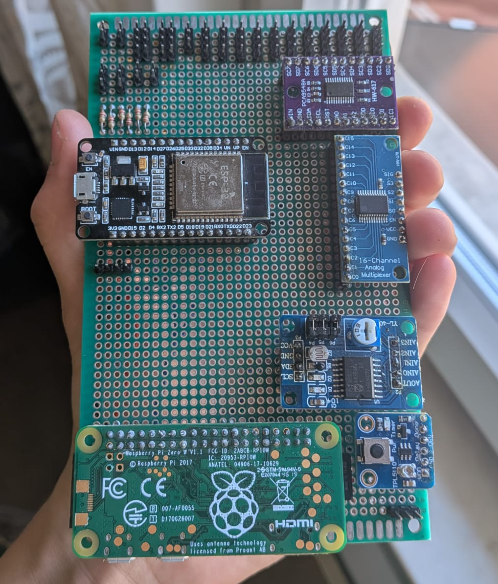
The complete board � all primary systems installed except the AIS receiver
The board uses a large double-sided prototyping PCB as the backbone. Everything is soldered in place � no breadboards, no loose wires. It plugs directly into the electronics enclosure and connects to the rest of the boat through waterproof M12 connectors and terminal blocks along the bottom edge.
Components
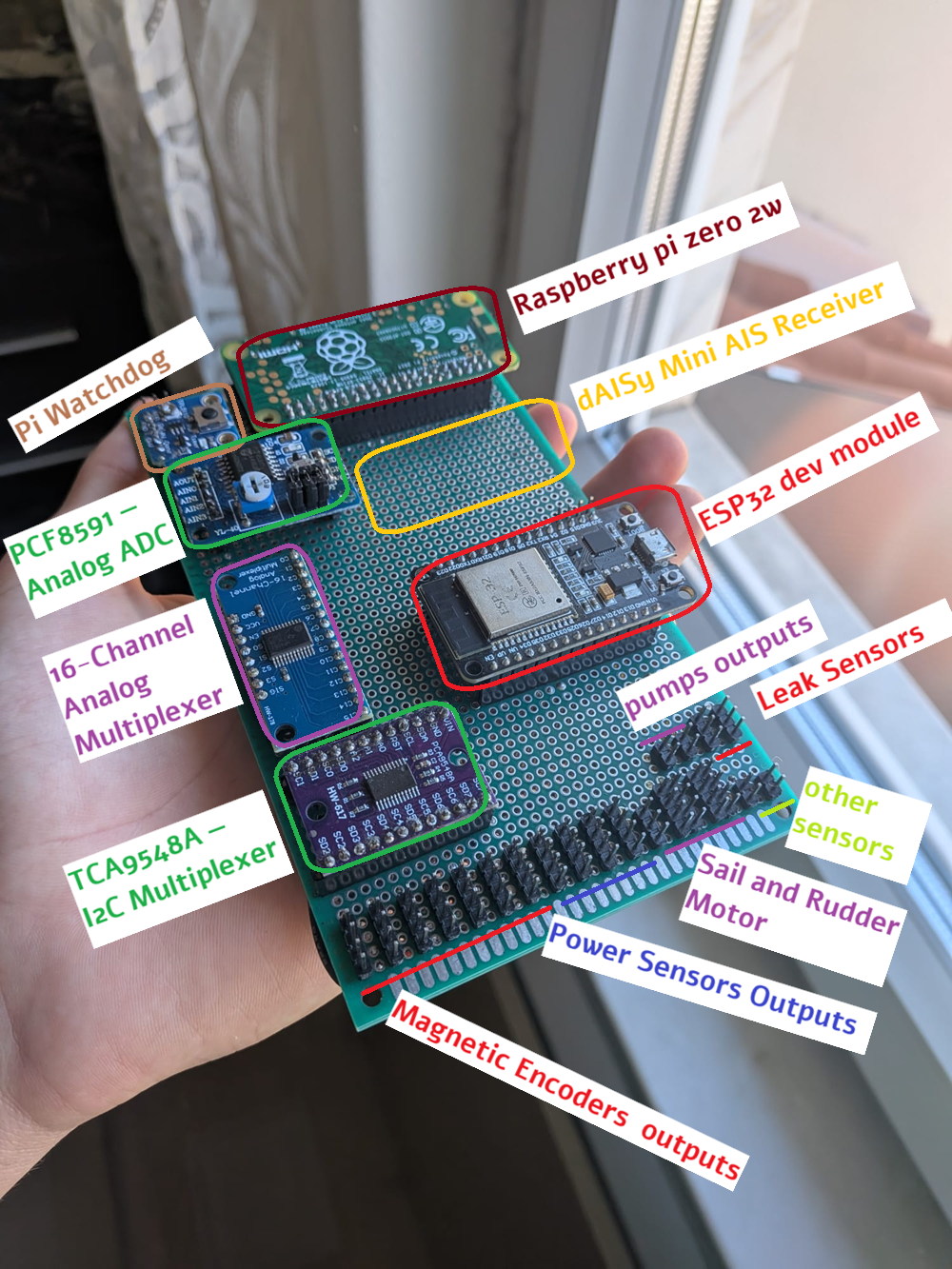
Here is what is on the board and what each part does:
What Each Part Does
Raspberry Pi Zero 2W
The main computer. Runs the Flask web dashboard, logs all sensor data to CSV, manages the simulated Iridium satellite comms, and talks to Pixhawk over MAVLink via GPIO. Low power draw makes it ideal for a solar-powered crossing.
ESP32
Handles everything real-time � reads the five AS5600 magnetic encoders for sail and rudder position, runs the PID motor control loops for the BTS7960 drivers, reads the wind vane and sends NMEA sentences to Pixhawk, and reports all data to the Pi over serial. WiFi and Bluetooth are disabled at sea to save power.
PCF8591 � Analog ADC
4-channel analog-to-digital converter connected to the Pi over I2C. Reads the light-dependent resistor for automatic navigation light control, two NTC thermistors for internal temperature monitoring, and one moisture sensor channel for hull leak detection.
16-Channel Analog Multiplexer
Extends the analog input capacity by routing up to 16 analog signals through a single ADC pin. Used for reading multiple sensors � INA219 power monitors, additional moisture probes � without adding separate chips for each channel.
TCA9548A � I2C Multiplexer
All five AS5600 magnetic encoders share the same I2C address (0x36), so they cannot normally coexist on the same bus. The TCA9548A gives each isolated channel its own address, letting the ESP32 address them individually. Channels 0�4 carry the wind, sail shaft, sail motor, rudder shaft, and rudder motor encoders respectively.
Terminal Blocks
The row of screw terminals along the bottom edge of the board is where all external connections land � motors, sensors, power supply, serial lines to Pixhawk. Every cable that leaves the electronics box passes through here, making the board easy to disconnect and service without cutting wires.
AIS Receiver
Not yet installedThe AIS receiver will be added when it arrives. It will monitor nearby commercial shipping traffic and feed vessel positions to the Pixhawk autopilot for collision avoidance routing. It will live in the same waterproof electronics enclosure as the rest of the board, connected via the spare terminal block positions already reserved for it.
The Back Side
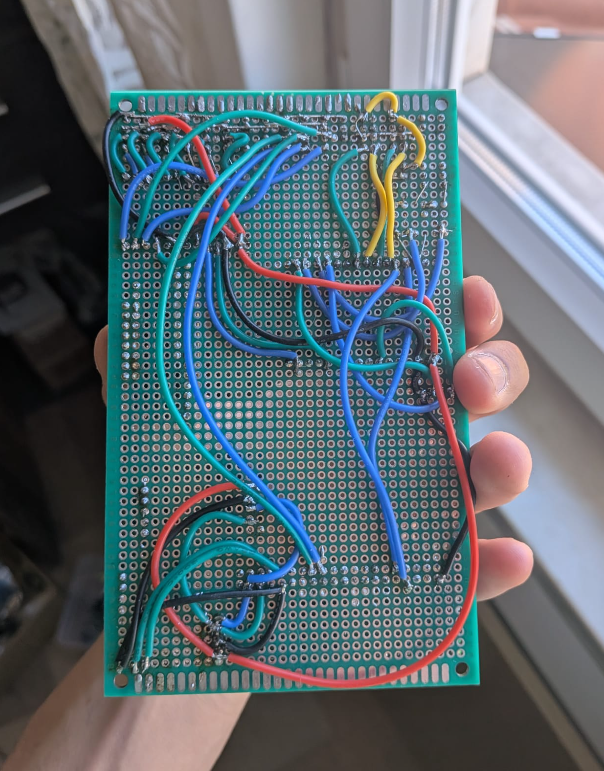
The underside of the board is where all the soldering lives. Every connection between modules runs through here , power rails, I2C buses, serial lines, ground planes. Nothing is left loose.
Into the Enclosure
The board will be 3D printed into a sealed enclosure alongside the other critical electronics , Pixhawk autopilot, RockBLOCK 9603 Iridium modem, AIS receiver, and the TPL5110 hardware watchdog. Everything the boat needs to navigate, communicate, and survive the Atlantic in one waterproof box.